
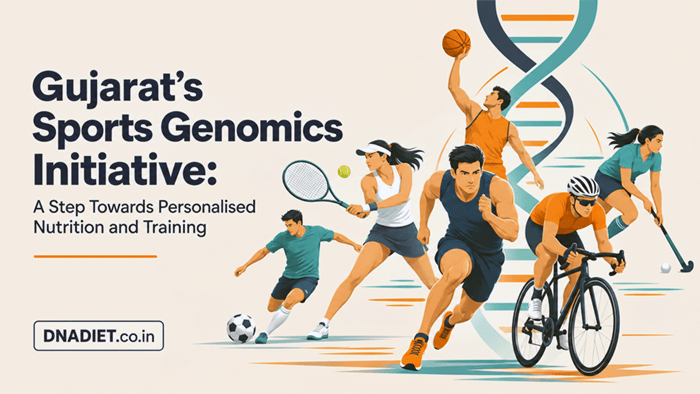
Gujarat’s Sports Genomics Initiative: A Step Towards Personalised Nutrition and Training
Ahmedabad, Gujarat: The Gujarat Government’s launch of a state-level Sports Genomics Programme is an encouraging development for the future of sports in India.
For more than a decade, we have been working in the field of DNA-based nutrition, and we have consistently believed that every individual is biologically unique. This understanding becomes particularly important in sports, where athletes can differ in their response to training, nutrition, recovery and physical demands.
The Gujarat Government has launched what has been described as India’s first state-level Sports Genomics Programme. The initiative aims to study the DNA of approximately 10,000 athletes over five years, with around 2,000 athletes participating each year.
Athletes from different age groups and sporting disciplines will be studied, with the programme looking at factors such as strength, endurance, muscle capacity, injury risk, recovery and nutritional requirements.
We welcome this initiative because we believe it can help take Indian sports towards a more personalised and science-informed approach to athlete development.
Why Personalisation Matters in Sports
Every athlete is different.
Two athletes may participate in the same sport, follow similar training schedules and have similar goals, but their bodies may still respond differently to training and nutrition.
One athlete may recover quickly after intense exercise, while another may need greater attention to recovery. Nutritional requirements can also vary between individuals. Similarly, athletes can have different characteristics related to endurance, muscle performance and other aspects of physical performance.
This is why we believe that a one-size-fits-all approach has limitations.
General sports nutrition and training principles remain extremely important. However, when we have additional information about an individual athlete, we can potentially make certain strategies more personalised.
This is where DNA-based approaches can add value.
“Every athlete is biologically unique. The same training, nutrition or recovery approach may not necessarily be equally suitable for every athlete. DNA-based insights can provide another layer of information that can help athletes and experts personalise their performance journey.”
The Role of DNA-Based Nutrition
Nutrition is one of the foundations of athletic performance.
An athlete needs appropriate nutrition to support energy, training, muscle development and recovery. But the nutritional strategy that works for one athlete may not necessarily be the same strategy that is most appropriate for another.
Our work in DNA-based nutrition focuses on understanding how genetic information can contribute to this personalisation.
Certain genetic characteristics may provide insights that can be considered when developing nutritional strategies. These insights can be looked at alongside the athlete’s sport, training schedule, lifestyle, goals and existing dietary habits.
The purpose is not to create a diet based only on DNA.
Instead, DNA can provide an additional layer of information that may help nutrition professionals develop a more individualised approach.
This allows us to move beyond the broad question of “What should an athlete eat?” and consider a more individualised question:
“What nutritional approach may be better suited to this particular athlete?”
We believe this is an important direction for the future of sports nutrition.
Personalised Training and Recovery
Sports Genomics also has potential relevance beyond nutrition.
Training programmes are often designed around the requirements of a particular sport. However, athletes within the same sport can have different physical characteristics and responses to exercise.
Understanding individual biological characteristics can potentially help coaches and sports professionals consider how training approaches may be personalised.
DNA-based information should therefore be viewed as an additional tool for coaches and sports professionals.
It does not replace experience, coaching or performance assessment. Instead, it can complement these areas by providing another perspective on the individual athlete.
The same principle applies to recovery.
An athlete’s training programme is only effective when the body has an opportunity to recover and adapt. Nutrition, sleep, hydration, rest and appropriate training loads are all important parts of recovery.
Individual biological information can potentially add another layer when developing a personalised recovery strategy.
For this reason, we believe nutrition, training and recovery should be considered together rather than in isolation.
Why Gujarat’s Initiative Is Important
The scale of the Gujarat Government’s programme makes it particularly significant.
Studying approximately 10,000 athletes over five years can help increase awareness about Sports Genomics among athletes, coaches, parents and sporting organisations.
It can also encourage more discussion about how genetic information can be incorporated into sports science.
For us, the most important aspect is the move towards understanding the individual athlete.
Sports science has already evolved significantly through performance tracking, exercise testing, sports nutrition, biomechanics, psychology and recovery science.
Genomics can become another part of this broader sports-performance ecosystem.
The more information we can appropriately gather about an athlete, the greater the opportunity to develop strategies that are tailored to that individual.
Our Experience With DNA-Based Nutrition
For more than a decade, our work has focused on DNA-based nutrition and the role that individual biological characteristics can play in personalised nutritional planning.
Dr. Rushikesh Trivedi has also founded the DNA Sports Programme, where DNA-based insights are applied in the broader context of personalised sports performance.
Our experience has reinforced one important principle: athletes should be understood as individuals, not simply as members of a particular sport or age group.
Their nutrition, training, recovery and performance goals need to be considered together.
DNA Is Not a Substitute for Hard Work
Supporting DNA-based nutrition and training does not mean suggesting that genetics alone determines athletic success.
We strongly believe that training, coaching, discipline, consistency and hard work remain fundamental to athletic performance.
DNA provides information about biological characteristics. It is then up to qualified professionals to understand that information and determine how it can be used alongside other factors.
An athlete still needs to train consistently.
They still need proper coaching.
They still need adequate nutrition and recovery.
What DNA-based approaches can potentially offer is greater personalisation within these established principles.
That is why we see genomics as an opportunity rather than a replacement for conventional sports science.
A Positive Development for Athletes and Parents
The government’s initiative can also help athletes and parents become more aware of personalised sports science.
For young athletes especially, understanding individual characteristics can become part of a broader approach to long-term development.
However, genetic information should always be considered alongside the athlete’s interests, abilities, training experience, sporting requirements and professional guidance.
The objective should be to use science to support better decisions—not to place limitations on an athlete based on genetic information.
We believe that every athlete should have the opportunity to develop through appropriate training, nutrition, coaching and support.
The Future of Sports Is Becoming More Personalised
We believe the future of sports performance will increasingly involve personalisation.
The combination of sports nutrition, personalised training, recovery science, sports psychology, technology and genomics can provide a more comprehensive understanding of an athlete.
DNA-based nutrition can contribute to this approach by providing information about individual biological characteristics.
Personalised training can help apply this understanding to the athlete’s physical development.
And personalised recovery can help support the athlete between training sessions and competitions.
The Gujarat Government’s Sports Genomics Programme is therefore a welcome step in this direction.
As Dr. Rushikesh Trivedi says:
“We have been advocating personalised sports performance for years. Now, it is encouraging to see Sports Genomics receiving recognition at the government level. This is an important step forward for Indian sports.”
We believe this initiative can help create greater awareness, encourage scientific exploration and make personalised approaches more accessible to athletes across Gujarat and, eventually, India.
The future of sports performance is not simply about training harder. It is about understanding the individual athlete better and using that understanding to make nutrition, training and recovery more personalised.
With Gujarat taking this important step, we believe India is moving closer to that future.
Connect With Dr. Rushikesh Trivedi
Athletes, parents, coaches and sports enthusiasts who would like to learn more about DNA-based nutrition and personalised nutritional approaches can connect with Dr. Rushikesh Trivedi and our clinic team.
Phone: +91 99 13 33 9031