

When people search for Papaya Nutrition chart and facts, they are usually looking for quick numbers. But in my experience of working with over 3000 patients across 10 countries, I have seen that numbers alone rarely tell the complete story. A fruit like papaya is not just a collection of vitamins and calories. It is a biologically active food that interacts differently with each individual depending on their metabolism, digestion, and genetic response.
Let us first understand the nutritional profile clearly before we go deeper into how papaya actually behaves in the body.
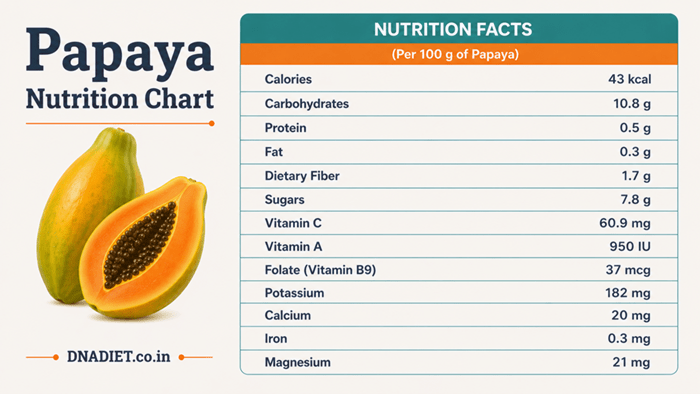
Papaya Nutrition Chart (Per 100 grams)
Here is a standard nutritional breakdown of ripe papaya:
- Calories: 43 kcal
- Carbohydrates: 10.8 grams
- Natural sugars: 7.8 grams
- Dietary fiber: 1.7 grams
- Protein: 0.5 grams
- Fat: 0.3 grams
Vitamins:
- Vitamin C: ~60 mg (more than 60% of daily requirement)
- Vitamin A (beta-carotene): ~950 IU
- Folate (Vitamin B9): ~37 mcg
Minerals:
- Potassium: ~182 mg
- Magnesium: ~10 mg
- Calcium: ~20 mg
At a glance, this Papaya Nutrition chart and facts section shows why papaya is considered nutrient-dense despite being low in calories.
What Makes Papaya Nutritionally Unique
Papaya is not just about vitamins. Its uniqueness lies in a combination of enzymes, antioxidants, and easily digestible nutrients.
1. Papain Enzyme
Papaya contains papain, a digestive enzyme that helps break down proteins.
This is one of the main reasons why papaya is often recommended after meals. It reduces digestive load and can help with heaviness or bloating.
However, from my perspective as a DNA-based nutrition expert, regular dependence on papaya for digestion may indicate underlying digestive inefficiency. It is supportive, not corrective.
2. High Vitamin C Content
Papaya provides more Vitamin C than many citrus fruits.
Vitamin C supports:
- Collagen formation
- Skin repair
- Antioxidant protection
- Iron absorption
But here is an important nuance. Individuals with higher oxidative stress or certain genetic tendencies may benefit more from Vitamin C-rich foods than others. This is where personalization becomes important.
3. Beta-Carotene and Vitamin A Conversion
Papaya is rich in beta-carotene, which converts into Vitamin A.
This supports:
- Vision
- Skin regeneration
- Immune function
However, conversion efficiency varies from person to person. Not everyone converts beta-carotene into Vitamin A effectively. So while papaya looks like a great source on paper, actual benefit differs.
This is something most generic Papaya Nutrition chart and facts discussions do not address.
Fiber Content: Light Yet Effective
Papaya contains soluble, gentle fiber. Unlike heavy fibrous foods, it is easy on the gut.
This makes it useful for:
- Sensitive digestion
- Recovery from gut issues
- Mild constipation
But again, if someone continues to struggle with digestion despite eating papaya daily, the issue is deeper than fiber intake.
Natural Sugars and Metabolic Impact
Papaya contains natural sugars, which contribute to its sweet taste.
Now this is where individual variation matters the most.
Some people:
- Process natural sugars efficiently
- Use them for energy without spikes
Others:
- Experience blood sugar fluctuations
- Store excess as fat more easily
So when people ask whether papaya helps in weight loss, my answer is always conditional.
Papaya is not fattening by default. But it is not universally weight-loss friendly either.
The Papaya Nutrition chart and facts need to be understood in the context of your metabolism.
Antioxidants and Inflammation
Papaya contains antioxidants such as:
- Vitamin C
- Beta-carotene
- Lycopene
These compounds help reduce oxidative stress.
Chronic inflammation is a root cause behind many lifestyle conditions today. While papaya contributes to reducing oxidative damage, it cannot independently resolve inflammation.
In my practice, I often see people relying on “healthy foods” but not addressing their body’s deeper inflammatory patterns.
Raw vs Ripe Papaya: A Key Difference
Papaya behaves differently depending on its stage of ripeness.
Raw Papaya:
- Lower sugar
- Higher enzyme activity
- Better for digestion support
Ripe Papaya:
- Sweeter
- Easier to consume
- Slightly reduced enzyme activity
Choosing between raw and ripe papaya should ideally depend on your digestive and metabolic profile.
This is rarely discussed in standard Papaya Nutrition chart and facts content, but it makes a significant difference.
Hydration and Electrolyte Support
Papaya has high water content and contains potassium.
This supports:
- Hydration
- Muscle function
- Fluid balance
In hot climates, this becomes especially useful. But it should not replace proper hydration habits.
Common Misunderstandings About Papaya
Over the years, I have seen certain repeated misconceptions.
“Papaya alone can fix digestion”
It supports digestion but does not address root causes.
“Papaya guarantees weight loss”
Weight loss depends on total metabolic balance, not one fruit.
“Papaya suits everyone”
Not true. Individual response varies significantly.
My Perspective as a DNA-Based Dietician
I do not evaluate food based on general labels like “healthy” or “unhealthy.”
I evaluate based on compatibility.
Papaya offers:
- Digestive enzyme support
- High Vitamin C
- Antioxidants
- Light fiber
- Hydration
But whether it benefits you depends on:
- Your genetic profile
- Your gut health
- Your metabolism
- Your inflammatory tendencies
I have seen people improve with regular papaya intake. I have also seen cases where reducing or timing its intake strategically improves outcomes.
That is why simply reading a Papaya Nutrition chart and facts is not enough.
Final Thought
Papaya is simple, accessible, and nutritionally rich. But its real value lies in how it fits into your body’s unique system.
The real question is not whether papaya is healthy.
The real question is whether papaya is working for you.
Because nutrition is not about food in isolation. It is about how your body responds to that food.
And that is where the difference between general nutrition and personalized, DNA-based nutrition truly begins.