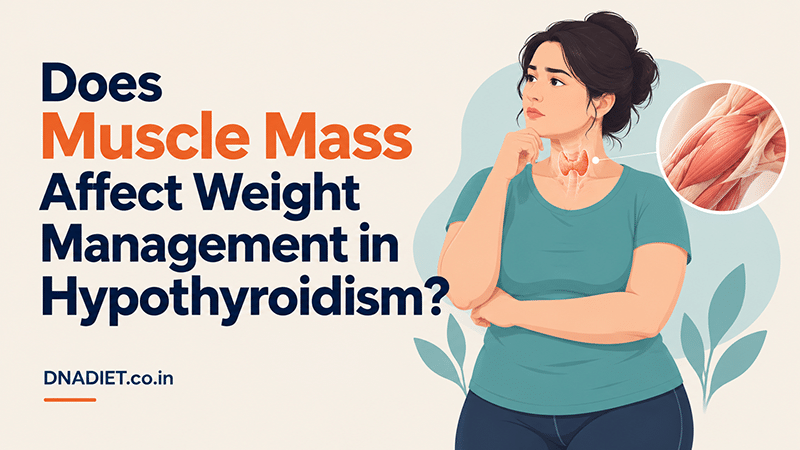
Does Muscle Mass Affect Weight Management in Hypothyroidism? Yes, but probably not for the reason you have been told. Muscle mass can influence energy expenditure, physical activity, strength and body composition, so preserving muscle while losing excess body fat can be important for someone with hypothyroidism. At the same time, hypothyroidism does not mean that every difficulty with weight is caused by a slow metabolism. An underactive thyroid can reduce energy expenditure and contribute to some weight gain, but a significant part of thyroid-related weight gain may be due to salt and water retention. Once thyroid function is appropriately treated, weight management still depends on nutrition, activity, body composition, sleep, age and several individual factors.
The question is not just “How much do you weigh?”
When someone with hypothyroidism comes to me because their weight is not moving, one of the first things I want to understand is what is happening inside that number on the weighing scale.
Two people can weigh exactly the same but have very different amounts of body fat and muscle.
Likewise, two people with the same thyroid diagnosis can have completely different weight-management challenges.
One person may have adequate muscle mass but excess body fat. Another may have spent years following restrictive diets and become less active, resulting in reduced muscle mass. Someone else may have recently started exercising but be frustrated because their weight has changed very little.
Treating all three people with the same diet simply because they have hypothyroidism would not make much sense.
That is why I believe body composition deserves more attention.
Why does muscle matter?
Muscle is living tissue that requires energy to maintain and use. More importantly, healthy muscle supports movement, strength and the ability to remain physically active.
This becomes relevant during weight loss.
When a person loses weight, the goal should ideally be to reduce excess fat while preserving as much healthy lean tissue as possible.
If someone follows an overly restrictive diet, becomes physically inactive or loses weight without paying attention to adequate nutrition and strength, some lean tissue may also be lost.
That can make the person’s body composition less favourable even though the number on the scale has gone down.
So instead of asking only:
“How many kilograms have I lost?”
I encourage patients to also ask:
“How much of that weight was fat, and how well am I preserving my muscle?”
That is a much more useful question for long-term weight management.
But does hypothyroidism automatically cause muscle loss?
Not necessarily.
This is an important distinction.
Hypothyroidism can affect muscles and physical function, and people with an underactive thyroid may experience symptoms such as weakness or fatigue. However, it would be an oversimplification to assume that every person with hypothyroidism has low muscle mass.
Your age, activity level, nutritional intake, previous dieting history, overall health and body composition all matter.
There is also another reason why the relationship between thyroid function and body weight can be misunderstood.
Not every kilogram associated with hypothyroidism represents newly accumulated body fat. According to the American Thyroid Association, much of the weight associated with hypothyroidism can be related to salt and water retention.
This is one reason I would not recommend judging your thyroid-related weight problem simply by looking at the scale.
Does building more muscle make you lose weight faster?
This is where many online articles oversimplify the science.
You may have heard that adding muscle dramatically “boosts your metabolism.”
Muscle does use energy, and maintaining muscle is valuable. But building a few kilograms of muscle does not suddenly transform your metabolism.
The more meaningful benefit may be what healthy muscle allows you to do.
When you are stronger, everyday movement can become easier. You may be able to walk longer, perform resistance exercises, climb stairs more comfortably and remain active for longer periods.
Physical activity itself contributes to energy expenditure and provides many health benefits. General weight-management guidance also recommends combining aerobic activity with muscle-strengthening activity.
So I would not tell a patient:
“Build muscle and your thyroid problem will disappear.”
That would be misleading.
I would say:
“Let’s protect your muscle while we work on your body composition.”
That is a very different approach.
What happens when you lose weight without protecting muscle?
Imagine two people each lose 10 kg.
Person A loses mostly excess body fat while maintaining a reasonable amount of lean tissue.
Person B loses weight through severe restriction and inactivity and loses a considerable amount of lean tissue along with body fat.
Both have lost 10 kg.
But their outcomes are not necessarily the same.
This is why sustainable weight management should not be reduced to a race to reach the lowest possible number on the weighing scale.
A successful plan should consider:
- Body fat
- Muscle mass
- Waist measurement
- Strength
- Physical activity
- Food quality
- Adequate nutrition
- Sustainable weight loss
The weighing scale is useful. It is simply not the whole story.
What about strength training?
For many people, resistance or strength training can be an excellent addition to a weight-management programme.
It does not necessarily mean spending hours in a gym.
Depending on the person’s fitness and health status, strength exercises can include body-weight exercises, resistance bands, dumbbells or gym-based resistance exercises.
The important part is choosing something appropriate for the individual and progressing gradually.
The National Institute of Diabetes and Digestive and Kidney Diseases recommends muscle-strengthening activities as part of regular physical activity and notes that such activities can help maintain muscle mass, including during weight loss.
However, someone who has been inactive for years should not copy an advanced workout programme from social media.
The right exercise is the one that is appropriate for your current body, fitness level and health situation.
Protein matters, but “more” is not always better
Muscle preservation is not only about exercise.
Nutrition matters too.
Protein provides the amino acids needed for maintaining and repairing muscle tissue. But that does not mean that everyone with hypothyroidism should suddenly start following a very high-protein diet.
Your protein requirement depends on factors such as body size, age, activity level, dietary pattern and overall health.
This is particularly important for people who have other medical considerations.
Instead of asking:
“Which high-protein diet should I follow?”
a better question is:
“How much protein do I actually need, and how should I fit it into my overall diet?”
That answer can be different for different people.
Why your thyroid test is only one part of the picture
A person may tell me:
“My thyroid is controlled, but I am still unable to lose weight.”
That is a very common concern.
It is tempting to assume that the thyroid must still be the reason.
But once hypothyroidism has been appropriately treated and thyroid hormone levels are in the normal range, the American Thyroid Association notes that the ability to gain or lose weight is broadly similar to that of people without thyroid disease.
That means we may need to look elsewhere.
How much are you eating?
What does your usual diet look like?
How much protein are you getting?
How active are you?
Have you lost muscle through repeated dieting?
How is your sleep?
What does your body composition look like?
Are you eating substantially more or less than you realise?
These questions can be more useful than simply increasing or decreasing calories again.
This is where personalised nutrition becomes important
There is no single “hypothyroidism diet” that will work in exactly the same way for every person.
A 35-year-old woman with Hashimoto’s disease who exercises regularly does not necessarily need the same approach as a 52-year-old man with hypothyroidism, obesity and a sedentary lifestyle.
Even two people of the same age, sex, height and weight may respond differently to the same dietary approach.
This is why, in my practice, I prefer to look at the person rather than just the diagnosis.
A DNA-based nutrition approach can be one component of that process. Genetic information may provide additional insight into certain nutritional and metabolic tendencies, but it should complement, not replace, appropriate medical evaluation and thyroid management.
The objective is not to find a magical thyroid diet.
The objective is to understand why your current approach is not producing the result you want and what needs to change.
What should you do if you have hypothyroidism and cannot lose weight?
Start by making sure your thyroid condition is appropriately managed with your doctor.
Then look beyond the thyroid.
Consider your body composition, eating pattern, protein intake, activity level, sleep, previous dieting history and ability to maintain muscle.
If you have been trying different diets for months or years and repeatedly losing and regaining weight, simply trying another generic diet may not answer the real problem.
Sometimes the most useful next step is not another diet chart.
It is a proper assessment.
A better way to measure progress
If you are working on weight management with hypothyroidism, consider tracking more than body weight.
Depending on your situation, useful measures can include:
Body weight: to understand the overall trend.
Waist circumference: to track changes in central body size.
Body composition: to understand changes in fat and lean tissue.
Strength and physical function: to see whether your ability to move and exercise is improving.
Diet adherence: because the best plan is one you can actually follow.
Energy and daily activity: because feeling better and becoming more active are meaningful outcomes too.
This broader view can prevent you from abandoning a sensible plan simply because the scale has temporarily stopped moving.
When should you consider personalised guidance?
If your thyroid levels are being managed but your weight remains difficult to control, if you have repeatedly lost and regained weight, or if you are unsure whether you are losing fat or muscle, a personalised nutritional assessment can be useful.
At a consultation, the important question is not simply:
“What should I eat?”
It is:
“What is happening in my particular case, and what should my nutrition strategy look like because of that?”
That is the difference between receiving another generic diet chart and having a nutrition plan built around you.
The bottom line
Muscle mass can matter in weight management with hypothyroidism, but it is not the entire explanation for difficulty losing weight.
Hypothyroidism can reduce energy expenditure and contribute to weight gain, while fluid retention can also affect the number on the scale. Once thyroid function is appropriately treated, however, long-term weight management still depends on the same broader fundamentals: nutrition, physical activity, body composition, sleep and sustainable habits.
So if you have hypothyroidism and your weight is not responding despite your efforts, don’t immediately assume that you need to eat less or exercise more.
First, understand what is actually happening with your body composition and your current nutrition strategy.
That is where personalised nutrition can make the conversation much more useful.
If you would like to understand whether your current weight-management difficulty is related to your diet, muscle mass, body composition or other individual factors, you can book a consultation with me for a personalised assessment. The aim is not to give you another generic diet, but to understand your situation and create a nutrition strategy that is appropriate for you.
This article is for general educational purposes and does not replace medical diagnosis or treatment. If you have hypothyroidism, continue prescribed thyroid medication and discuss medication or dose changes with your treating doctor.