
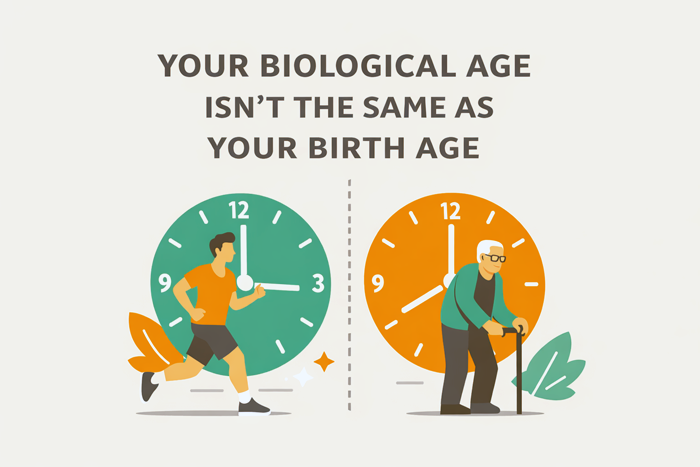
Most of us proudly state our age based on the number of years since birth. But science tells a more nuanced story. Your birth (chronological) age is simply a number on paper, while your biological age reflects how your body is actually functioning at a cellular and metabolic level. In many cases, these two ages don’t match—and that gap can explain why some people feel energetic and healthy well into their 40s and 50s, while others struggle with fatigue, weight gain, or early lifestyle disorders much earlier.
What Is Biological Age, Really?
Biological age measures how well your body systems are performing compared to what’s expected at a certain age. It is influenced by factors such as:
- Metabolism efficiency
- Organ health
- Hormonal balance
- Inflammation levels
- Nutrient absorption
- Lifestyle habits like sleep, stress, diet, and physical activity
If your biological age is higher than your birth age, your body is ageing faster than expected. If it’s lower, your body is functioning more youthfully—something many people aspire to, often unknowingly.
Why Diet Plays a Central Role in Ageing
Every cell in your body responds to what you eat. Food doesn’t just provide calories; it sends signals that affect gene expression, inflammation, fat storage, detoxification, and repair mechanisms. The challenge is that no single diet works for everyone.
One person may thrive on higher carbohydrates, while another experiences insulin resistance. Some people process fats efficiently; others store them easily. These differences are not random—they are written into your DNA.
Enter DNA-Based Nutrition
A DNA-based diet moves away from generic meal plans and instead aligns nutrition with your unique genetic makeup. By understanding how your genes influence metabolism, nutrient absorption, inflammation, and ageing pathways, nutrition can be tailored to support how your body is designed to function.
This approach focuses on:
- Optimizing metabolism instead of forcing weight loss
- Reducing chronic inflammation that accelerates ageing
- Supporting cellular repair and recovery
- Improving energy levels and mental clarity
- Enhancing long-term organ health
Rather than chasing short-term results, DNA-based nutrition works from the inside out—where ageing truly begins.
Slowing Ageing From Within
Ageing isn’t just about wrinkles or grey hair; it’s about declining cellular efficiency. Poorly matched diets can stress the body, leading to oxidative damage, hormonal imbalance, and metabolic slowdown. Over time, this pushes biological age higher.
When nutrition matches genetic needs, the body experiences less internal stress. Cells repair more efficiently, metabolism improves, and inflammation reduces. The result is not just better lab reports, but also real-life improvements—better stamina, improved digestion, healthier body composition, and a stronger sense of overall well-being.
Feeling Younger Is a Biological Process
Many people associate “feeling younger” with motivation or mindset alone. While mindset matters, biology plays a bigger role. When your internal systems function efficiently, energy levels rise naturally, sleep improves, and recovery becomes easier. These are signs of a lower biological age—not wishful thinking.
A DNA-aligned diet supports these processes by giving your body what it actually needs, not what’s trending on social media.
A Smarter Way to Invest in Long-Term Health
Health is not about fighting ageing—it’s about ageing well. Understanding your biological age gives you clarity, while DNA-based nutrition gives you a roadmap. Instead of experimenting endlessly with diets, you work with your body rather than against it.
At DNA Diet, the focus is on personalized nutrition guided by your genetic blueprint—helping you improve metabolism, slow biological ageing, and build sustainable health from within.
Because when nutrition aligns with who you truly are, your body responds in ways no generic diet ever can.