
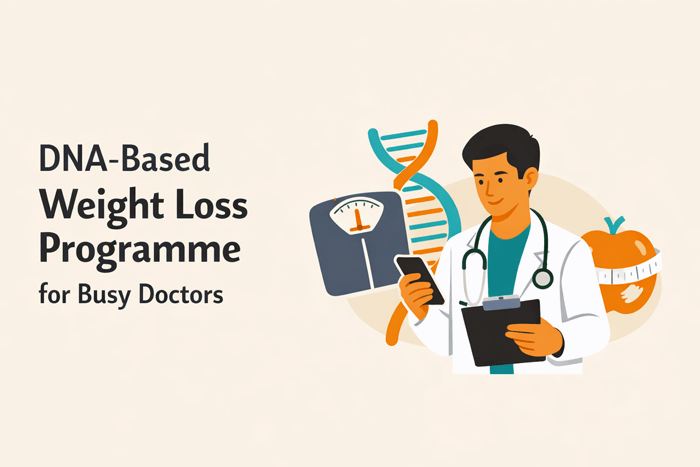
If you are a doctor and reading this, let me start by saying this very clearly—I am not here to lecture you about diet, because you already know more about health, disease, and metabolism than most people ever will. I am here because, over the years, I have seen one consistent pattern: doctors are brilliant at taking care of everyone except themselves. Long OPDs, emergencies, surgeries running late, night duties, academic pressure, conferences, and family responsibilities mean your life simply does not fit into a neat “diet plan template,” and it never truly will. This is not your failure; this is your reality—and that is precisely why A DNA-Based Weight Loss Programme for Busy Doctors exists.
Let me be honest. Most doctors I meet tell me some version of this: “I know what to eat, but I just can’t follow it.” And every time, I tell them the same thing—the problem is not discipline, and it is certainly not lack of knowledge. The problem is that most diet plans are designed for predictable lifestyles, not for clinical lives. They assume fixed meal timings, mental bandwidth to plan food, and a routine that medical practice simply does not allow.
As doctors, we are also unusually hard on ourselves. We advise patients to lose weight, reverse lifestyle diseases, and improve metabolic health, and when we struggle ourselves, we internalise guilt. But medicine teaches us something very important: no intervention works unless it matches the patient’s biology and context. The same rule applies to us.
There are a few diet myths that even doctors get trapped in. One is the idea that calories are calories. Biochemically, you know this is incomplete. Two people eating the same calories can have entirely different insulin responses, lipid handling, inflammation levels, and fat storage patterns. Another belief is that more willpower will solve the problem. Hunger, satiety, stress eating, and cortisol response are genetically regulated; willpower cannot override biology indefinitely. Then there is the assumption that exercise will compensate for dietary mismatch. Exercise is vital for health, but weight loss is largely metabolic, and genetic variations strongly influence how each body responds to cardio, resistance training, and recovery.
This is where DNA-based nutrition changes the conversation completely. A DNA-based weight loss programme does not start with food charts or restrictions. It starts with your genetic blueprint. By analysing key genetic markers, we understand how your body processes carbohydrates, how it responds to dietary fats, how efficiently you absorb protein, your inflammation tendencies, your micronutrient needs, and your stress and cortisol response. From there, nutrition is designed to work with your biology, not against it.
Doctors respond particularly well to this approach because it is rooted in mechanism, not motivation. DNA-based nutrition explains why a certain food supports your metabolism and why another one quietly sabotages it. It clarifies why intermittent fasting works brilliantly for some doctors and backfires for others, and why the same “healthy diet” gives different outcomes in different people. When the logic is clear, adherence becomes natural rather than forced.
Equally important, this approach respects the reality of medical life. I do not design plans assuming you will cook three perfect meals a day or exercise for an hour daily. DNA-based programmes are built for unpredictable schedules, hospital food realities, travel, conferences, and decision fatigue. When nutrition aligns with genetics, hunger reduces, energy stabilises, and food stops feeling like a daily negotiation.
For doctors, weight loss is never just cosmetic. What concerns me far more are the silent metabolic risks I see among colleagues—insulin resistance, fatty liver, dyslipidemia, chronic inflammation, and stress-driven metabolic dysfunction. DNA-based nutrition is not about short-term dieting; it is about long-term metabolic protection and preventive medicine for the doctor.
I am Dr. Rushikesh Trivedi, and I work in DNA-based nutrition because I believe doctors deserve the same level of personalised, evidence-driven care that they give their patients every day. I understand the clinical world, I respect your time, and I know that simplistic diet advice has no place in modern medicine.
Doctors take care of people’s health. We take care of doctors’ health.
One doctor for another.
Let’s discuss your fitness journey
Whatsapp Now: 99133 39031