

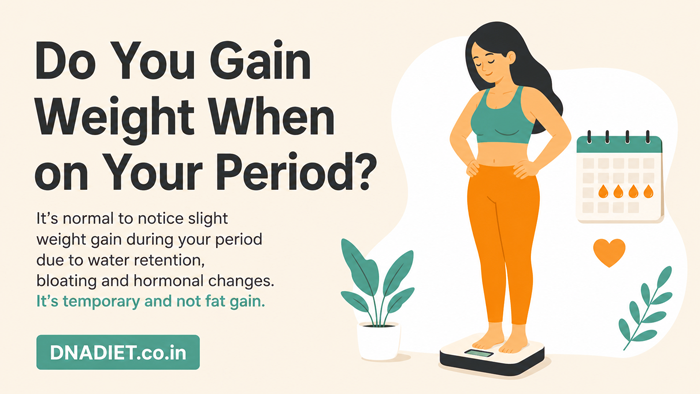
As a DNA-based nutrition expert, one of the most common concerns I hear from women is: Do You Gain Weight When on Your Period?
If you have ever stepped on the weighing scale during your menstrual cycle and felt frustrated, let me tell you this clearly. You are not alone, and more importantly, you are not actually gaining fat.
Let me explain this from both a scientific and practical perspective.
What I See in My Practice
Over the years, I have worked with thousands of women, and a very clear pattern emerges. Almost every woman experiences some degree of weight fluctuation during her menstrual cycle.
Typically, this increase ranges between 0.5 to 2 kilograms. Naturally, this creates anxiety. Many start questioning their diet, their discipline, or even their metabolism.
But here is the truth I consistently explain. This is not fat gain. It is a temporary physiological response.
What Is Actually Happening Inside Your Body
Your body is governed by hormones, and during your menstrual cycle, these hormones fluctuate significantly, especially estrogen and progesterone.
These hormonal shifts impact multiple systems in your body.
1. Water Retention Is the Biggest Factor
In my observation, the most common reason behind this weight increase is water retention.
When hormone levels change, your body tends to hold on to more sodium and fluids. This leads to bloating, especially around your abdomen, thighs, and sometimes even your face.
So when you see the scale going up, what you are actually seeing is extra water weight, not fat.
2. Digestive Changes
I also notice that many women experience slower digestion during this phase.
You may feel:
- Heaviness
- Constipation
- A fuller stomach even after small meals
This again contributes to that “gained weight” feeling, but it is simply your digestive system responding to hormonal changes.
3. Cravings and Appetite Changes
Another common pattern I see is increased cravings, especially for sweets and carbohydrates.
This is not about lack of control. It is your body responding to fluctuations in serotonin and blood sugar regulation.
Now, let me be very clear here. Occasional indulgence will not make you gain fat.
However, if this turns into a repeated pattern every month, it can contribute to long-term weight gain. But that is a cumulative effect, not something that happens during a single period cycle.
4. Insulin Sensitivity Fluctuations
From a metabolic standpoint, hormonal changes can slightly reduce insulin sensitivity during certain phases of your cycle.
This means your body may not handle glucose as efficiently as it usually does. As a result, you may feel more tired or crave quick energy foods.
Again, this is temporary.
So, Do You Gain Weight When on Your Period?
Let me answer this directly, because this is where most confusion lies.
Do You Gain Weight When on Your Period?
Yes, your weight may increase, but it is not fat gain.
It is primarily due to:
- Water retention
- Hormonal fluctuations
- Digestive slowdown
This is temporary and reversible.
Is This Weight Gain Permanent?
No. And I say this with complete confidence based on years of clinical experience.
Once your cycle ends and your hormone levels stabilize, your body naturally releases the excess water it was holding.
Your weight returns to its normal baseline.
If it does not, then we need to look at other factors, not your period.
The Mistake I See Women Make
What concerns me more than the weight fluctuation itself is how women react to it.
I often see:
- Sudden crash dieting
- Skipping meals
- Excessive exercise
- Feeling guilty for eating
This reaction is far more harmful than the temporary weight increase.
Your body is already under hormonal stress. Punishing it further disrupts your metabolism.
Why a DNA-Based Approach Matters
In my work, I strongly emphasize that no two bodies respond the same way.
Some women are genetically more prone to:
- Water retention
- Hormonal sensitivity
- Strong cravings
- Slower metabolism during certain phases
This is why generic diet plans fail.
A DNA-based diet helps us understand:
- How your body processes nutrients
- How you respond to hormonal fluctuations
- What triggers bloating or cravings in your body
When you understand your genetic blueprint, you stop guessing and start responding intelligently.
This becomes even more important in conditions like PCOS and PCOD, where hormonal imbalance, insulin resistance, and unexplained weight gain are very common. In my clinical experience, women struggling with these conditions often follow multiple diets without results because the root cause is not being addressed. A DNA-based diet allows us to identify how your body uniquely responds to carbohydrates, fats, inflammation, and hormonal stress. By aligning nutrition with your genetic profile, we can reduce unnecessary fat gain, improve metabolic efficiency, and support better hormonal balance in a more sustainable way.
What You Should Expect and Accept
During your period, it is completely normal to experience:
- Slight increase in weight
- Bloating and puffiness
- Lower energy levels
- Mild digestive discomfort
- Increased appetite
I always tell my clients that this is not a problem to fix. It is a phase to understand.
Common Misconceptions I Want to Correct
“I gain fat during my period”
No, you do not. Fat gain requires sustained overeating over time.
“I should eat less to control weight”
Not necessarily. Your body actually needs nourishment during this phase.
“I should avoid activity”
Movement can actually help you feel better physically and mentally.
When I Advise You to Pay Attention
While most changes are normal, I do recommend deeper evaluation if:
- Your weight does not normalize after your cycle
- You experience extreme bloating
- Your cycles are irregular
- You notice a steady increase in weight month after month
These may indicate underlying hormonal or metabolic imbalances.
My Final Message to You
Let me leave you with the same question we started with, because the answer becomes clearer once you understand your body:
Do You Gain Weight When on Your Period?
Yes, the scale may go up, but your body is not gaining fat. It is simply responding to natural hormonal changes.
As Dr. Rushikesh Trivedi, I always encourage you to move away from fear-based reactions and toward understanding your body at a deeper level.
When you do that, you stop chasing quick fixes and start building long-term balance.
And that is where real health begins.