

One of my obese female patients lost 7 kg in the first month and another 5 kg in the second month. Her husband, who was also following our DNA-based diet, lost 4 kg in the first month and 4 kg in the second month.
Same home. Same food environment. Same scientific approach.
Yet, completely different outcomes.
This is exactly why the question—“How Much Time Does It Take to Lose 10 kg?”—cannot have a one-size-fits-all answer. Because weight loss is not just about eating less or exercising more. It is about how your body is designed to respond.
So, How Long Does It Really Take to Lose 10 kg?
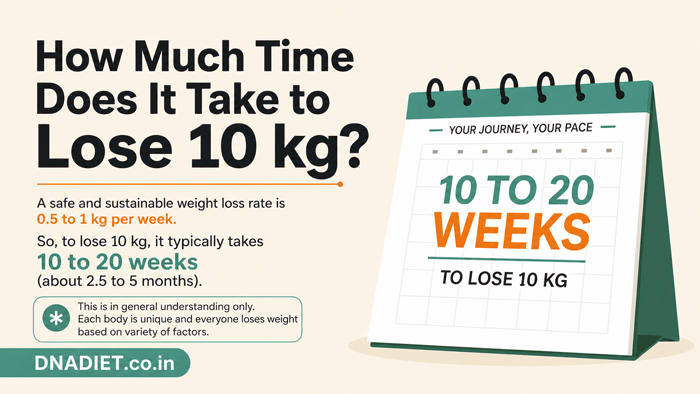
If we talk about a safe, sustainable, and medically sound approach, most individuals can lose:
- 0.5 to 1 kg per week
Which means:
- 10 kg weight loss = approximately 10 to 20 weeks
- Roughly 2.5 to 5 months
However, this is just a general guideline—not a fixed rule.
Some people lose weight faster in the beginning, especially if they have higher body fat. Others may experience slower but steady progress. The key is not speed—the key is sustainability.
Because rapid weight loss often leads to rapid weight gain.
Why Weight Loss Is Not the Same for Everyone
If weight loss were purely about calories, everyone following the same diet would get identical results.
But that doesn’t happen.
Why?
Because your body is influenced by multiple internal factors:
1. Metabolic Rate
Some individuals naturally burn calories faster, while others conserve energy more efficiently. This difference alone can change your weight loss speed significantly.
2. Hormonal Health
Conditions like thyroid imbalance, insulin resistance, or PCOD can slow down fat loss—even if your diet looks “perfect” on paper.
3. Genetic Blueprint
Your DNA determines:
- How you process carbohydrates and fats
- Your tendency to store fat
- Your hunger and satiety patterns
- Your response to workouts
This is the most ignored factor in traditional diet plans.
The Hidden Problem with Generic Diets
Most people try multiple diets before they see results—keto, intermittent fasting, low-fat, detox plans.
Some work temporarily. Most fail long-term.
Not because you lack discipline—but because those diets are not designed for your body.
For example:
- A person with poor fat metabolism may struggle on a high-fat keto diet
- Someone else may feel constantly hungry on a low-carb plan
So what happens?
You keep switching diets, hoping the next one will finally work.
This trial-and-error approach is not just frustrating—it wastes years.
The DNA-Based Solution: Stop Guessing, Start Knowing
At DNA Diet, we follow a different philosophy:
Don’t follow trends. Follow your biology.
Using Nutrigenomics, we analyze your genetic profile to understand exactly how your body functions.
A DNA-based diet helps us identify:
- The ideal balance of carbs, fats, and protein for you
- Your fat storage tendencies
- Your metabolic efficiency
- Food sensitivities
- Your best-suited type of exercise
This transforms weight loss from a guessing game into a targeted, scientific process.
Does a DNA-Based Diet Help You Lose 10 kg Faster?
The real benefit is not just speed—it is precision.
When your diet aligns with your genetic makeup:
- Your body responds more efficiently
- Fat loss becomes consistent
- Plateaus reduce
- Cravings are controlled naturally
This is why people who struggled for years often start seeing results within weeks—not because they are working harder, but because they are finally working right.
Key Factors That Influence Your Weight Loss Speed
Even with the right plan, several factors determine how quickly you lose 10 kg:
1. Your Starting Point
Higher initial weight often leads to faster early results.
2. Consistency
No plan works without discipline. Daily habits matter more than occasional effort.
3. Muscle Mass
More muscle means higher calorie burn—even at rest.
4. Sleep and Stress
Poor sleep and high stress can disrupt hormones and slow down fat loss significantly.
5. Food Quality
It’s not just about calories—it’s about how your body reacts to those calories.
The Biggest Mistake: Chasing Quick Fixes
Many people want to lose 10 kg as quickly as possible.
So they:
- Drastically cut calories
- Skip meals
- Follow extreme diets
And yes, they may lose weight quickly.
But here’s the reality:
- Most of that loss is water and muscle
- Metabolism slows down
- Weight regain becomes almost inevitable
This creates a frustrating cycle of losing and gaining—often ending at a higher weight than before.
Shift Your Focus: Fat Loss Over Weight Loss
Instead of asking, “How fast can I lose 10 kg?”, ask:
- Am I losing fat or muscle?
- Is my metabolism improving?
- Can I sustain this lifestyle long-term?
Because true success is not reaching a number on the scale—it is maintaining it effortlessly.
What a Successful 10 kg Journey Looks Like
With a personalized, DNA-based plan, your transformation is structured and realistic:
- Weeks 1–3: Better digestion, improved energy, reduced bloating
- Weeks 4–6: Noticeable fat loss, reduced cravings
- Weeks 8–12: Visible body changes, improved strength
- Beyond 12 weeks: Sustainable lifestyle and long-term control
This is not a temporary diet—it is a permanent correction of how your body functions.
Final Thoughts: Your Timeline Is Personal
So, how long does it take to lose 10 kg?
The honest answer is:
It depends on your body—and how well you understand it.
You can continue following generic plans and hope for results.
Or you can take a scientific approach and work with your body, not against it.
Because weight loss is not about doing more.
It is about doing what is right for you.
If you are serious about losing 10 kg—and more importantly, keeping it off—it’s time to stop guessing.
Your DNA already holds the answers.
You just need the right approach to unlock them.