
Can junk food be part of a weight-loss journey? As a Best dietician in Ahmedabad, I often explain to my clients that the answer is not as simple as saying, “5% junk food is fine for everyone.” At the heart of DNA-based nutrition is a very different way of looking at food.
We often classify foods as healthy or unhealthy, good or bad, weight-loss friendly or fattening. But the human body is far more individual than these labels suggest.
The same food can produce different responses in different people.
Your genetic makeup can influence how your body processes and responds to various nutrients, including carbohydrates, fats and certain micronutrients. It can also influence tendencies related to appetite, satiety, metabolism and how your body handles particular dietary patterns.
This is one of the reasons a DNA-based weight-loss journey does not begin with the question:
“What is the best diet for everyone?”
It begins with:
“What kind of nutrition is best suited to YOUR body?”
So, if approximately 5% of your overall food intake comes from foods generally considered “junk food,” it may be perfectly compatible with a successful weight-loss journey provided several important conditions are met, and provided those foods are compatible with your individual genetic and nutritional profile.
Your Body Does Not Read Food Labels
A food packet may say “healthy,” “low-fat,” “high-protein” or “natural.”
But your body does not respond to marketing labels.
It responds to the nutrients entering your digestive system and the complex biological processes that follow.
And those responses can vary between individuals.
For example, two people may eat the same carbohydrate-rich food and experience different metabolic responses. Similarly, the way individuals respond to dietary fats, caffeine, certain nutrients or particular food patterns can differ.
This is where genetics becomes an important piece of the nutrition puzzle.
DNA-based nutrition attempts to understand these individual differences and use them to make dietary recommendations more personalised.
Instead of blindly copying somebody else’s weight-loss diet, the objective is to understand what may work better for your body.
So, When Is 5% Junk Food Fine?
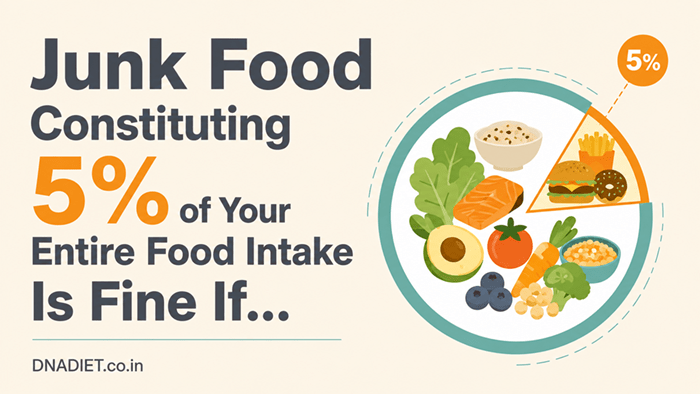
The 5% concept makes sense when it exists within an otherwise personalised and nutritionally sound diet.
Imagine your total food intake as 100%.
If approximately 95% consists of foods selected according to your nutritional requirements and DNA-based dietary recommendations, the remaining small proportion can potentially provide room for flexibility and enjoyment.
That might mean occasionally enjoying:
- A slice of pizza
- A small serving of fries
- A dessert
- Chocolate
- A burger
- A favourite bakery item
- A meal at a social gathering
But there is an important distinction.
The question isn’t simply whether the food is “junk food.” The question is whether it fits into your overall nutritional strategy.
1. If Your 95% Is Designed for YOUR Body
This is perhaps the most important condition.
A conventional diet may tell everyone to eat the same foods.
A DNA-based nutrition approach starts from the premise that individual nutritional responses matter.
Your genetic profile can provide insights that may help determine which dietary patterns and nutrient combinations are more appropriate for you.
For one person, a particular carbohydrate source may fit comfortably into their diet. Another person may need a different carbohydrate strategy.
One person may do well with a certain balance of macronutrients, while another may require a different approach.
Therefore, your “95%” should not simply mean:
“I eat healthy food.”
It should mean:
“I eat the foods and proportions that are appropriate for my body and my individual nutritional requirements.”
That is a fundamentally different approach.
2. If Your DNA-Based Diet Is Working With Your Biology, Not Against It
Weight loss is not simply about eating fewer calories or exercising more.
Those factors matter, but the human body is a complex biological system.
Genetics can influence how individuals respond to food, physical activity and different dietary patterns.
This is why two people can follow apparently similar diets and experience different outcomes.
One person may lose weight easily with a particular dietary approach, while another may struggle despite apparently following the same plan.
DNA-based nutrition attempts to move away from the “one diet fits all” model and towards a more individualised approach.
The objective is not to find a magical food.
It is to understand your biological tendencies better and use that information to build a nutritional strategy around you.
3. If Junk Food Remains the Exception, Not the Foundation
A DNA-based diet does not mean you can eat unlimited junk food simply because your genetic profile has been analysed.
Your genetic profile is not a permission slip for poor nutrition.
Highly processed, calorie-dense foods can still make it difficult to maintain appropriate energy intake and adequate nutritional quality.
The 5% concept works because the majority of your diet remains focused on nutrition.
Think of it this way:
Your DNA may help personalise the foundation. Your food choices determine how consistently you follow that foundation.
The occasional indulgence should remain occasional.
4. If Portion Size Is Controlled
Five percent does not mean five percent of your calories can become an excuse for unlimited portions.
There is a major difference between enjoying a small portion of dessert and consuming an entire box of sweets.
Likewise, eating a small serving of fries occasionally is different from making fried food a regular component of your meals.
Even when a food fits within your personalised plan, quantity still matters.
A sustainable weight-loss journey requires learning how to enjoy food without allowing enjoyment to turn into habitual overeating.
5. If the Food Fits Your Individual DNA-Based Recommendations
This is where the idea of “junk food” becomes particularly interesting.
Suppose two people both love the same food.
A conventional approach might simply say:
“Both of you can have it occasionally.”
A DNA-based approach asks a deeper question:
“How does this food fit into each person’s individual nutritional profile?”
The answer may not necessarily be identical.
A food that is relatively easy for one person to incorporate into their diet may not be the best choice for another person, depending on their genetic predispositions and broader nutritional requirements.
That is why a DNA-based nutrition plan should not simply provide a generic list of foods to eat and avoid.
It should help create a personalised food strategy.
6. If You Understand That Weight Loss Is Not a Competition
One of the biggest mistakes people make is comparing their weight-loss journey with someone else’s.
“His diet worked.”
“She lost 10 kg eating this.”
“My friend eats rice every day and is still slim.”
“But I gained weight eating the same thing.”
These comparisons can be misleading.
You are not genetically identical to your friend.
Your nutritional requirements, genetic predispositions, lifestyle, activity levels, sleep, eating behaviour and other factors may all be different.
Therefore, somebody else’s successful diet is not automatically your ideal diet.
The goal of DNA-based nutrition is to move away from imitation and towards personalisation.
7. If You Don’t Turn “Cheat Food” Into a Cheat Day
The word “cheat” itself can sometimes create an unhealthy relationship with food.
One indulgent meal does not need to become an entire day of unrestricted eating.
If you want to enjoy pizza, enjoy pizza.
If you want dessert, enjoy dessert.
But then return to your normal eating pattern.
The biggest problem is often not the food itself. It is the behavioural chain that follows it:
One dessert → “I have already broken my diet” → overeating → guilt → abandoning the diet → starting again Monday.
A sustainable DNA-based weight-loss journey should not depend on perfection.
It should depend on consistency.
8. If Your Indulgence Doesn’t Replace Essential Nutrition
There is another important distinction.
Your 5% should ideally represent flexibility around your nutritional foundation, rather than replacing it.
If your body requires adequate protein, fibre, micronutrients and other nutrients, those requirements cannot be ignored simply because you have technically stayed within a percentage.
Your body needs nutrition, not merely calorie control.
This is why a DNA-based nutrition programme should consider the quality and suitability of your overall diet rather than focusing exclusively on weight on the weighing scale.
9. If You Understand That DNA Is the Starting Point for Personalisation
DNA-based nutrition is not about saying:
“Your genes determine everything.”
It is about recognising that your genetics can provide valuable information about how your body may respond to nutrition, and that this information can be used alongside your lifestyle and other individual factors to create a more personalised approach.
Your genes are part of the biological blueprint.
Your food choices, activity, sleep and lifestyle are the factors you work with every day.
The objective is to bring these elements together rather than following a generic diet simply because it worked for somebody else.
10. If 5% Helps You Stay Consistent
Ultimately, the greatest value of allowing some flexibility is behavioural sustainability.
A person who believes they can never eat their favourite foods may eventually find the diet impossible to maintain.
A person who understands that their nutritional foundation is personalised, and that there can be controlled room for enjoyment, is more likely to maintain the plan over the long term.
And long-term consistency matters enormously in a weight-loss journey.
You don’t need to eat perfectly every day. You need to make the right choices consistently enough for your body to benefit.
The 5% Is Not the Point. Personalisation Is.
The headline may say that junk food constituting 5% of your food intake can be fine.
But the real message is much bigger.
There is no universal percentage that magically makes junk food healthy.
The important principle is that your overall diet should be nutritionally appropriate, sustainable and personalised to your individual needs.
And that is precisely where DNA-based nutrition can change the way we think about weight loss.
Instead of asking:
“What should I eat to lose weight?”
Ask:
“What does my body need, and how does my genetic profile influence the way I respond to different foods?”
Once you understand that, food stops being a simple list of “good” and “bad” choices.
It becomes a personalised nutritional strategy.
So yes, enjoy that occasional pizza.
Have that dessert at a celebration.
Eat your favourite food without guilt.
But make sure the other 95% is doing the real nutritional work, and that your 95% is designed around YOU.
Because in DNA-based nutrition, the goal is not simply to eat less.
The goal is to eat smarter for your body.